

DeltaCert-Agent: Selective Security Recertification for Evolving Tool-Using LLM Agents
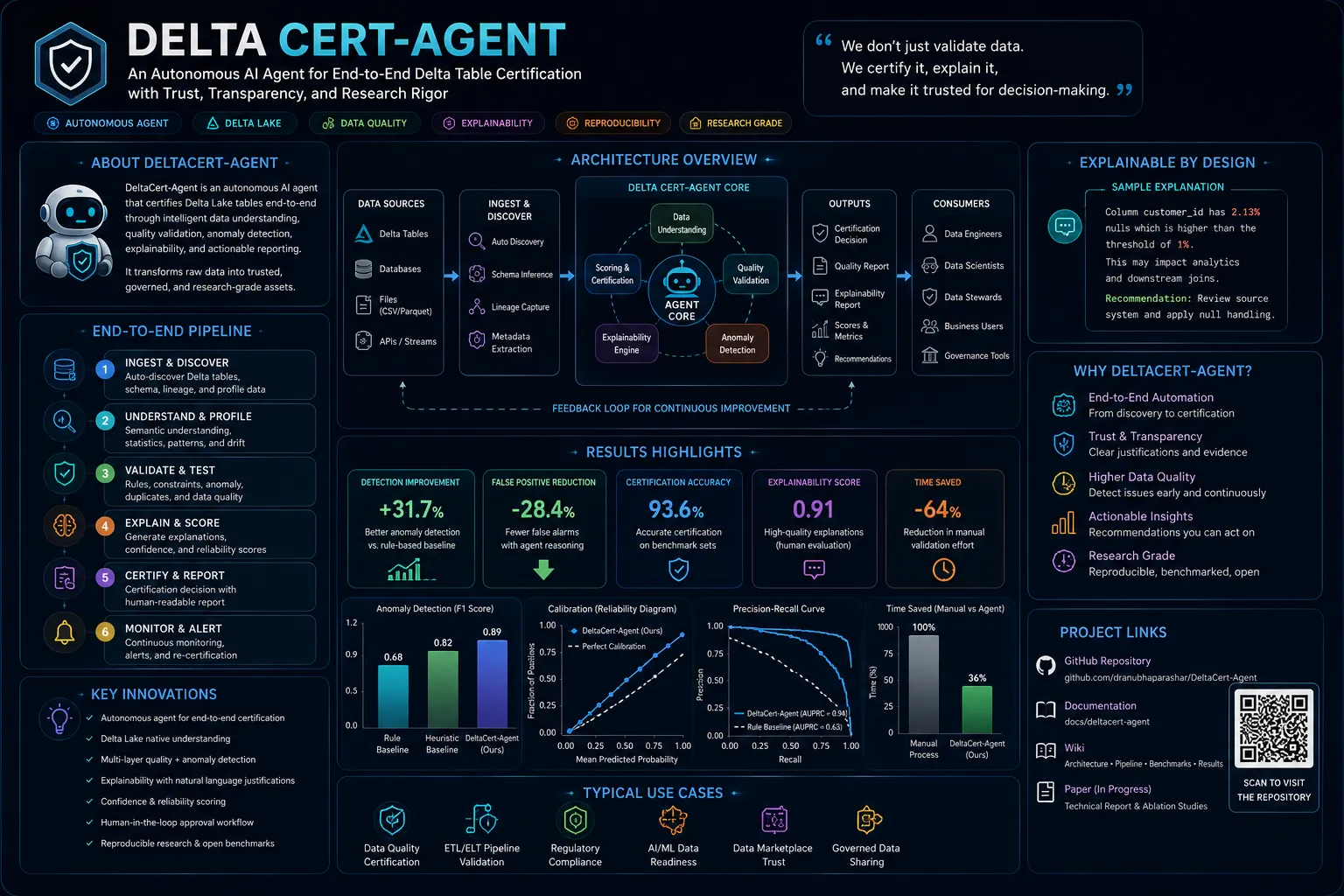
Inside the System
Project overview
A change-impact-aware security recertification framework for evolving tool-using LLM agents that maps configuration changes to affected assurance claims, selects scoped tests, executes risk-triggered sentinels, and escalates to broader recertification when impact cannot be bounded safely.
Result
Controlled Evaluation0.7502 recall regression detection vs 0.5501 equal-budget random
31,396 evidence rows · four local models · five repetitions
How was this measured?
- Evaluation
- 31,396 evidence rows · four local models · five repetitions
- Scope
- Controlled Evaluation
- Baseline
- Equal-budget random test selection (mean recall 0.5501).
- Method
- DeltaBench mutations were evaluated across four local Ollama models in five repetitions; recall and test reduction were aggregated from resumable evidence traces.
Business Problem
Tool-using LLM agents do not remain static.
A deployed agent can change because of:
- a different model or model version,
- a changed system or developer prompt,
- a new or modified tool,
- tool-schema changes,
- permission changes,
- policy updates,
- memory or retrieval changes,
- dependency changes,
- runtime-control changes,
- environment changes.
Any of these can invalidate security evidence collected for the previous configuration.
The naive response is:
Any change
   ↓
Run every security test again
   ↓
Issue / reject certificate
That is safe in principle, but expensive and difficult to scale.
DeltaCert-Agent instead asks:
What changed?
   ↓
Which assurance claims can be affected?
   ↓
Which tests provide evidence for those claims?
   ↓
Are additional high-risk sentinel tests required?
   ↓
Is selective recertification sufficient?
   ↓
If not, escalate to broader / full recertification
From: Why This Project Exists
Proposed Solution
DeltaCert-Agent determines which security tests need to be rerun after an LLM-agent configuration change, while preserving evidence, escalating on uncertainty, and producing an auditable recertification decision.
From: One-Line Idea
Outcome
Documented in project articleMean regression-detection recall improves from the equal-budget random baseline's 0.5501 to 0.7502 while executing 61.35% fewer tests on average; 95% recall CI is 0.7153–0.7841 across 31,396 evidence rows.
Cost and Risk Reduction
Not quantifiedQuantified financial impact has not yet been documented.
Deployment Context
Local research framework using Ollama and resumable experiment scripts; no public production deployment is claimed.
Key Capabilities
- Agentic AI
- Security
- Explainability
Evidence and Project Links
Related Projects
Engineering review
Technical Summary
A change-impact-aware security recertification framework for evolving tool-using LLM agents that maps configuration changes to affected assurance claims, selects scoped tests, executes risk-triggered sentinels, and escalates to broader recertification when impact cannot be bounded safely.
System Architecture
Versioned agent manifest → change fingerprint → assurance/impact graph → selective test planner → DeltaBench execution and oracles → runtime evidence and traces → certificate status, with ambiguous or high-risk impact escalating to full recertification.
Algorithms and Models
Dataset / Data Basis
- Data / Evaluation Basis
- DeltaBench scenarios and mutations, versioned agent manifests, assurance/impact graphs, policy profiles, and resumable runtime traces from repeated local Ollama executions.
- Dataset size / benchmark scale
- 31,396 recorded evidence rows from five repetitions of the completed journal run across Qwen3 4B, Gemma3 4B, Llama 3.2 3B, and Phi-4 Mini.
Evaluation
Primary measures are regression-detection recall and test-reduction ratio, with task success, malicious-proposal rate, runtime containment, attack success, latency, bootstrap confidence intervals, McNemar's exact test, paired permutation testing, and paired effect size.
Reproducibility Links
Original project record
Complete Technical Article
Original diagrams, implementation notes, code, tables, equations, metrics and documented limitations are preserved below.
DeltaCert-Agent is a research framework for selective security recertification of evolving tool-using LLM agents.
DeltaCert-Agent is built around a simple problem:
When an AI agent changes, should every security test be rerun — or can we determine what changed, which assurance claims are affected, which tests matter, and when a full recertification is actually necessary?
The framework treats recertification as a change-impact and evidence-selection problem rather than a blind full-suite rerun.
It combines versioned agent manifests, deterministic change fingerprinting, assurance-graph reasoning, selective test planning, risk-triggered sentinel tests, execution oracles, resumable real-model evaluation, and bounded certificate decisions inside one reproducible pipeline.
Project Links
View the GitHub Repository
Open the public repository on GitHub.
- GitHub: https://github.com/dranubhaparashar/deltacert-agent
- Wiki: https://github.com/dranubhaparashar/deltacert-agent/wiki
- Results: https://github.com/dranubhaparashar/deltacert-agent/wiki/Results
- Architecture: https://github.com/dranubhaparashar/deltacert-agent/wiki/Architecture
One-Line Idea
DeltaCert-Agent determines which security tests need to be rerun after an LLM-agent configuration change, while preserving evidence, escalating on uncertainty, and producing an auditable recertification decision.
Why This Project Exists
Tool-using LLM agents do not remain static.
A deployed agent can change because of:
- a different model or model version,
- a changed system or developer prompt,
- a new or modified tool,
- tool-schema changes,
- permission changes,
- policy updates,
- memory or retrieval changes,
- dependency changes,
- runtime-control changes,
- environment changes.
Any of these can invalidate security evidence collected for the previous configuration.
The naive response is:
Any change ↓Run every security test again ↓Issue / reject certificateThat is safe in principle, but expensive and difficult to scale.
DeltaCert-Agent instead asks:
What changed? ↓Which assurance claims can be affected? ↓Which tests provide evidence for those claims? ↓Are additional high-risk sentinel tests required? ↓Is selective recertification sufficient? ↓If not, escalate to broader / full recertificationProject at a Glance
| Item | Description |
|---|---|
| Project Type | Security / AI-assurance research framework |
| Primary Domain | Tool-using LLM-agent security recertification |
| Core Problem | Avoid unnecessary full-suite security reruns after configuration changes |
| Core Mechanism | Change fingerprint → assurance graph → selective test plan |
| Baseline | Equal-budget random test selection |
| Runtime Evidence | Real local LLM execution through Ollama |
| Models Evaluated | Qwen3 4B, Gemma3 4B, Llama 3.2 3B, Phi-4 Mini |
| Repetitions | 5 in the completed journal run |
| Recorded Evidence Rows | 31,396 |
| Primary Metric | Regression-detection recall |
| Efficiency Metric | Test-reduction ratio |
| Implementation | Python |
| Local Model Runtime | Ollama |
System Architecture
The architecture is deliberately conservative.
Selective testing is allowed only when the impact of the change can be bounded with enough confidence. When the impact is ambiguous or sufficiently high-risk, the system escalates.
Core Research Pipeline
1. Versioned Agent Manifest
DeltaCert-Agent begins with a structured representation of the agent configuration.
A manifest can include:
Model identityPrompt configurationTool inventoryTool schemasPermissionsPoliciesMemory / retrieval configurationDependenciesRuntime controlsEnvironment metadataThe manifest creates an explicit object that can be compared across agent versions.
2. Change Fingerprinting
Instead of reasoning from an informal statement such as:
“We only changed one thing.”
DeltaCert-Agent computes a deterministic change fingerprint.
Conceptually:
where:
- is the previously evaluated configuration,
- is the candidate configuration,
- is the security-relevant configuration delta.
The fingerprint identifies which security-relevant components changed.
3. Assurance / Impact Graph
A change does not directly map to a certificate decision.
It first maps to the assurance claims that may no longer be supported.
The graph therefore connects:
configuration elements ↓assurance claims ↓tests ↓evidenceThis provides the basis for change-aware test selection.
4. Selective Test Planner
Selective Test Set
Let:
- be the full security test suite,
- be tests selected because of the observed change,
- be risk-triggered sentinel tests.
The final selective suite is:
The planner is not required to remain selective.
When impact cannot be bounded safely:
meaning the system escalates to full recertification.
What Is Being Measured?
The central experimental question is:
Can a change-aware planner detect more induced security regressions than an equal-budget random selector while executing substantially fewer tests than the complete suite?
For a changed configuration, let:
- be the set of regressions revealed by the full suite,
- be regressions detected by DeltaCert’s selected tests.
Recall
Regression-detection recall is:
when at least one regression is present.
Reduction
The efficiency measure is test reduction:
A strong result therefore requires both:
- useful regression-detection recall, and
- meaningful reduction in test execution.
Real-Model Experiment
The completed journal experiment used four locally hosted model profiles:
ollama-qwen3-4bollama-gemma3-4bollama-llama3.2-3bollama-phi4-miniThe run was executed with repeated real-model calls and resumable evidence collection.
The final evidence cache contained:
31,396 recorded evidence rows
The experiment was intentionally resumable so that failures such as model-server interruption or machine shutdown would not require discarding completed evidence.
Main Result
DeltaCert vs Equal-Budget Random Selection
| Metric | Result |
|---|---|
| Mean regression-detection recall | 0.7502 |
| 95% bootstrap CI | 0.7153 – 0.7841 |
| Equal-budget random recall | 0.5501 |
| Mean test reduction | 0.6135 |
| 95% bootstrap CI for test reduction | 0.5873 – 0.6390 |
| Paired Cohen’s | 0.5042 |
| McNemar exact p-value | 4.14 × 10⁻¹⁷ |
| Paired permutation p-value | 9.999 × 10⁻⁵ |
| Recorded API cost | $0.00 |
| Total evidence rows | 31,396 |
DeltaCert-Agent improves mean regression-detection recall from:
55.01% → 75.02%
while reducing executed tests by:
61.35% on average
The absolute improvement over equal-budget random selection is approximately:
+20.01 percentage points
Model-Level Results
| Model | Regression Recall | Test Reduction | Task Success | Malicious Proposal | Runtime Containment | Attack Success | Mean Latency |
|---|---|---|---|---|---|---|---|
| Qwen3 4B | 0.9088 | 0.6135 | 0.0002 | 0.0000 | 1.0000 | 0.0000 | 99.63 s |
| Gemma3 4B | 0.6351 | 0.6135 | 0.4092 | 0.3167 | 0.8114 | 0.0597 | 21.94 s |
| Llama 3.2 3B | 0.7968 | 0.6135 | 0.5038 | 0.9520 | 0.9378 | 0.0592 | 23.44 s |
| Phi-4 Mini | 0.6601 | 0.6135 | 0.7390 | 0.0417 | 0.1328 | 0.0362 | 22.93 s |
Why the Model-Level Results Matter
A central finding is that security, utility, and runtime behavior are not the same thing.
Qwen3 4B
Qwen produced the highest recertification recall and complete runtime containment, but almost no successful task completion.
That means:
High security recall alone is not sufficient evidence of a useful agent.
Llama 3.2 3B
Llama achieved strong regression recall and moderate task success, but produced a very high malicious-proposal rate.
Runtime controls prevented most malicious behavior from succeeding.
That distinction matters:
unsafe model proposal ≠successful unsafe executionDeltaCert-Agent therefore records proposal behavior separately from containment and final attack success.
Phi-4 Mini
Phi-4 Mini achieved the strongest task-success rate among the evaluated profiles and relatively low attack success, but lower regression-detection recall than Qwen and Llama.
This illustrates a practical security–utility trade-off.
Security Outcome Model
The project intentionally distinguishes several layers of agent behavior:
A system can therefore produce:
- malicious proposals that are contained,
- benign proposals that fail the task,
- successful tasks,
- successful attacks,
- safe refusals,
- execution failures.
These outcomes should not be collapsed into one accuracy number.
Why Equal-Budget Random Selection?
A full-suite baseline answers:
What happens if we test everything?
But that does not isolate the value of the selective planner.
DeltaCert therefore uses an equal-budget random selector:
DeltaCert selects N tests vsRandom baseline selects N testsThis comparison asks:
Given the same test budget, does change-aware selection find more regressions than random selection?
The completed results show that it does under the evaluated protocol.
Statistical Evidence
The final experiment reports multiple forms of statistical evidence.
McNemar’s Exact Test
Paired Permutation Test
Paired Effect Size
The result therefore is not presented merely as a difference between two point estimates.
Resumable Evidence Collection
Real-model experiments can fail because of:
- local Ollama shutdown,
- machine restart,
- network interruption,
- disk-space exhaustion,
- process interruption,
- long model latency.
DeltaCert-Agent records evidence incrementally.
Conceptually:
execute scenario ↓record evidence row ↓persist cache ↓continueWhen execution stops:
existing evidence ↓preserved ↓resume only missing workThis was essential for the completed 31,396-row experiment.
Reproducibility Pipeline
01 Define versioned agent configuration02 Build / load benchmark scenarios03 Apply controlled mutation04 Compute change fingerprint05 Traverse assurance / impact mapping06 Generate selective test plan07 Add risk-triggered sentinel tests08 Execute selected tests09 Execute full-suite reference evaluation10 Run equal-budget random baseline11 Record model and runtime evidence12 Persist resumable JSONL cache13 Aggregate mutation-level results14 Aggregate model-level results15 Compute confidence intervals16 Run paired statistical tests17 Generate result tables18 Generate paper evidence19 Generate HTML report20 Audit claim scope and reproducibilityTechnology Stack
| Layer | Technology |
|---|---|
| Language | Python |
| Local LLM Runtime | Ollama |
| Models | Qwen3, Gemma3, Llama 3.2, Phi-4 Mini |
| Experiment Automation | Python / PowerShell |
| Evidence Storage | JSON / JSONL / CSV |
| Statistical Analysis | Python scientific stack |
| Reporting | Markdown / HTML / JSON |
| Testing | Pytest |
| Containerization | Docker |
| Version Control | Git / GitHub |
Repository Structure
deltacert-agent/├── assurance/├── configs/├── deltabench/├── docs/├── paper/│ └── generated/│ └── live/├── policies/├── schemas/├── scripts/├── src/├── tests/├── run_demo.py├── run_full_experiment.py├── run_live_experiment.py├── resume_full_paper_fixed.ps1├── pyproject.toml├── requirements.txt├── Dockerfile├── docker-compose.yml├── CITATION.cff├── CONTRIBUTING.md├── SECURITY.md└── README.mdWhat Makes DeltaCert-Agent Different
A conventional evaluation process looks like:
Agent changed ↓Run everything again ↓Pass / FailDeltaCert-Agent instead uses:
Agent change ↓Change fingerprint ↓Assurance impact ↓Risk-aware test selection ↓Sentinel checks ↓Real execution evidence ↓Selective certificate decision ↓Escalate when necessaryThe goal is not to weaken security testing.
The goal is to make security evidence change-aware, auditable, and economically reusable.
Research Integrity
DeltaCert-Agent intentionally separates:
- planner performance from model safety,
- malicious proposal from successful attack,
- runtime containment from model behavior,
- task success from security recall,
- selective evaluation from universal certification,
- measured evidence from unsupported generalization.
The scope of the completed result is therefore:
Real/local-model benchmark evidence bounded to the configured models, versions, scenarios, prompts, mutations, and sandbox policies.
It does not mean:
DeltaCert guarantees the safety of every LLM agent.
What Is Currently Supported
Supported by completed evidence
- selective change-aware recertification can reduce executed tests substantially under the evaluated benchmark;
- DeltaCert detects more regressions than equal-budget random selection under the completed protocol;
- the improvement is supported by paired statistical testing;
- performance differs substantially by underlying LLM profile;
- model proposal behavior and runtime attack success can differ significantly;
- resumable local-model evidence collection works at large experiment scale.
Not yet established universally
- safety guarantees for arbitrary agent frameworks;
- generalization to every model family or hosted API;
- universal prompt-injection resistance;
- universal tool-use security;
- production certification authority status;
- regulatory certification equivalence.
Current Research Direction
The next DeltaCert-Agent stage should focus on:
- broader model-family evaluation,
- hosted-model replication,
- additional mutation families,
- stronger planner ablations,
- cross-framework agent evaluation,
- calibration of impact uncertainty,
- explicit certificate-expiry policies,
- adversarial change-impact attacks,
- cost-aware test planning,
- external reproduction of the benchmark.
Central Research Claim
DeltaCert-Agent provides change-impact-aware selective security recertification for evolving tool-using LLM agents by mapping configuration changes to affected assurance claims and tests, improving regression detection over equal-budget random selection while substantially reducing full-suite test execution under the evaluated real-model protocol.
Repository
GitHub: https://github.com/dranubhaparashar/deltacert-agent
Wiki: https://github.com/dranubhaparashar/deltacert-agent/wiki
Architecture: https://github.com/dranubhaparashar/deltacert-agent/wiki/Architecture
Results: https://github.com/dranubhaparashar/deltacert-agent/wiki/Results
Final Experiment Snapshot
Evidence rows 31,396Mean regression recall 75.02%Random baseline recall 55.01%Mean test reduction 61.35%Recall 95% CI 71.53% – 78.41%Test reduction 95% CI 58.73% – 63.90%Cohen's d 0.504McNemar exact p 4.14e-17Permutation p 9.999e-05Recorded API cost $0.00DeltaCert-Agent does not recertify everything by default. It recertifies what the change can affect, preserves the evidence trail, and escalates when selective assurance is not defensible.
Comments