

AI-Powered Telecom Copper Reclamation: Document Intelligence and Workflow Automation for ACR/CAPR/CPR Analysis
Inside the System
Project overview
A decision-support and workflow-modernization platform for telecom copper reclamation that parses ACR, CAPR, and CPR reports, normalizes cable-pair evidence, generates conservative review recommendations, models With-SOW and Without-SOW processes, and provides a FastAPI and React/Vite foundation for governed automation.
Business Problem
Telecom copper-reclamation work is not a single document-processing task. It is a cross-functional decision process involving engineering reports, cable and pair records, circuit evidence, planning information, field observations, design packages, quality-control steps, permits, O-Calc activities, customer-impact checks, and operational approvals.
A large part of this work is still coordinated through PDF reports, spreadsheets, emails, manual lookups, and repeated handoffs. Engineers may need to:
- locate and interpret ACR, CAPR, and CPR reports;
- identify cable, count, terminal, circuit, and pair-level information;
- determine whether a pair appears working, assigned, defective, spare, or unresolved;
- reconcile IN COUNT, OUT COUNT, and QUALIFIED PAIRS relationships;
- consolidate evidence into review workbooks;
- compare With-SOW and Without-SOW operating processes;
- estimate where automation could reduce repetitive work;
- retain enough evidence for engineering review and audit.
This project organizes those activities into two complementary layers:
- Document intelligence and decision support for extracting and normalizing evidence from ACR/CAPR/CPR reports.
- Workflow modernization for exposing process data through FastAPI and presenting workflow phases, automation opportunities, and savings scenarios in a React/Vite dashboard.
The goal is not automatic decommission authorization. The goal is to reduce avoidable manual effort, improve consistency, make decision reasons visible, and create a foundation for a governed human-review workflow.
From: Why This Project Exists
Proposed Solution
Transform fragmented telecom reclamation evidence and multi-stage engineering processes into a structured, explainable, reviewable workflow—without allowing automated parsing to replace authoritative engineering, customer-impact, billing, field, safety, permit, or operational approvals.
From: One-Line Idea
Outcome
Documented in project articleText extraction, deterministic pair/status and ACR count parsing, example CSV/JSON/XLSX outputs, process-flow API, and the React/Vite dashboard shell are implemented; parser-to-dashboard integration and production authorization remain incomplete.
Cost and Risk Reduction
Not quantifiedQuantified financial impact has not yet been documented.
Deployment Context
Working PrototypePrototype runnable as a local Python parser with FastAPI and a React/Vite dashboard; it is not presented as a production-authorized telecom decision system.
From: Current Implementation Status
Key Capabilities
- Document Intelligence
- Workflow Automation
- Data Analytics
Evidence and Project Links
Related Projects
Engineering review
Technical Summary
A decision-support and workflow-modernization platform for telecom copper reclamation that parses ACR, CAPR, and CPR reports, normalizes cable-pair evidence, generates conservative review recommendations, models With-SOW and Without-SOW processes, and provides a FastAPI and React/Vite foundation for governed automation.
System Architecture
ACR/CAPR/CPR PDFs → PyMuPDF extraction → report-family and pair/count parsing → raw-status preservation and conservative normalization → warnings and preliminary recommendation → CSV/JSON/XLSX exports, alongside FastAPI process flows and the React dashboard shell.
Algorithms and Models
Dataset / Data Basis
- Data / Evaluation Basis
- ACR, CAPR, and CPR PDF reports, pair and count evidence, process-flow configuration, and the parser's CSV, JSON, and XLSX review outputs.
Evaluation
The prototype includes generated parser tests and documents production measures such as field precision/recall, row extraction accuracy, unparsed-row rate, false-clear rate, coverage, reviewer agreement, cycle time, rework, and exceptions; no trained or evaluated ML model or published accuracy result is claimed.
Reproducibility Links
Original project record
Complete Technical Article
Original diagrams, implementation notes, code, tables, equations, metrics and documented limitations are preserved below.
AI-Powered Telecom Copper Reclamation Workflow Automation Platform is a decision-support and workflow-modernization prototype for analyzing ACR, CAPR, and CPR reports, classifying cable-pair evidence, generating conservative reclamation recommendations, mapping engineering workflows, and identifying opportunities for governed automation.
View the GitHub Repository
Open the public repository on GitHub.
Wiki documentation: Home · About the Platform · Architecture and Design · ACR/CAPR/CPR Parsing · Decision Logic
Application documentation: Workflow Variants · Dashboard and Frontend · API Reference · Installation and Local Run
Engineering and governance: Testing and Validation · Security, Privacy, and Claim Boundary · Known Issues and Roadmap
One-Line Idea
Transform fragmented telecom reclamation evidence and multi-stage engineering processes into a structured, explainable, reviewable workflow—without allowing automated parsing to replace authoritative engineering, customer-impact, billing, field, safety, permit, or operational approvals.
Why This Project Exists
Telecom copper-reclamation work is not a single document-processing task. It is a cross-functional decision process involving engineering reports, cable and pair records, circuit evidence, planning information, field observations, design packages, quality-control steps, permits, O-Calc activities, customer-impact checks, and operational approvals.
A large part of this work is still coordinated through PDF reports, spreadsheets, emails, manual lookups, and repeated handoffs. Engineers may need to:
- locate and interpret ACR, CAPR, and CPR reports;
- identify cable, count, terminal, circuit, and pair-level information;
- determine whether a pair appears working, assigned, defective, spare, or unresolved;
- reconcile IN COUNT, OUT COUNT, and QUALIFIED PAIRS relationships;
- consolidate evidence into review workbooks;
- compare With-SOW and Without-SOW operating processes;
- estimate where automation could reduce repetitive work;
- retain enough evidence for engineering review and audit.
This project organizes those activities into two complementary layers:
- Document intelligence and decision support for extracting and normalizing evidence from ACR/CAPR/CPR reports.
- Workflow modernization for exposing process data through FastAPI and presenting workflow phases, automation opportunities, and savings scenarios in a React/Vite dashboard.
The goal is not automatic decommission authorization. The goal is to reduce avoidable manual effort, improve consistency, make decision reasons visible, and create a foundation for a governed human-review workflow.
Project at a Glance
| Area | Description |
|---|---|
| Project type | Industrial decision-support and workflow-automation prototype |
| Domain | Telecom copper reclamation and decommission planning |
| Primary inputs | ACR, CAPR, and CPR PDF reports; process-flow configuration |
| Document-processing output | Parsed metadata, pair records, count relationships, normalized statuses, warnings, and preliminary recommendation |
| Workflow output | With-SOW and Without-SOW process views, phase durations, automation opportunities, and savings scenarios |
| Backend | Python, FastAPI, Pydantic, Uvicorn |
| Frontend | React, TypeScript, Vite, Tailwind CSS, Framer Motion |
| Parsing | PyMuPDF and deterministic Python rules |
| Data processing | pandas, CSV, JSON, XLSX |
| Main users | Telecom engineering teams, planning teams, field operations, design/QC teams, workflow analysts, and automation engineers |
| Current maturity | Documented prototype requiring further integration, validation, security controls, and production hardening |
| Safety boundary | Decision support only; human engineering and field validation remain mandatory |
What Makes the Platform Different
The project treats copper reclamation as both an evidence problem and a workflow problem.
| Conventional approach | Platform approach |
|---|---|
| Read each report manually | Extract report metadata and pair-level evidence into structured records |
| Interpret status codes independently | Normalize known statuses and preserve raw evidence |
| Maintain findings in disconnected spreadsheets | Produce repeatable CSV, JSON, and XLSX outputs |
| Provide a binary recommendation without explanation | Return conservative decision categories with reason codes and warnings |
| Compare workflows informally | Model With-SOW and Without-SOW process variants as structured data |
| Estimate savings without process transparency | Tie savings scenarios to documented activities and configurable assumptions |
| Treat missing parsed evidence as absent | Convert uncertain or unparsed evidence into warnings and manual review |
| Allow automation to imply operational approval | Explicitly separate decision support from decommission authorization |
Important: The repository name uses “AI-Powered,” but the inspected document-analysis implementation is currently deterministic and rule-based. It is not yet a trained or independently validated machine-learning model.
Reader Walkthrough
A reader can understand the platform in eight steps:
- ACR, CAPR, and CPR PDF reports are collected for a candidate reclamation project.
- The parser extracts text with PyMuPDF and detects the report family.
- Metadata, cable/count sections, pair rows, statuses, defects, and available circuit identifiers are parsed.
- Raw statuses are normalized into working, review-required, defective, spare, or unknown categories.
- Evidence is aggregated into a conservative recommendation: HOLD, ENGINEERING REVIEW REQUIRED, or PROCEED CANDIDATE.
- Structured results are exported for engineering review in CSV, JSON, or XLSX form.
- The FastAPI and React layers represent the broader reclamation workflow, including With-SOW and Without-SOW process variants.
- Human reviewers verify all authoritative systems, field conditions, customer impact, permits, design dependencies, and approved work procedures before any operational action.
Platform Architecture
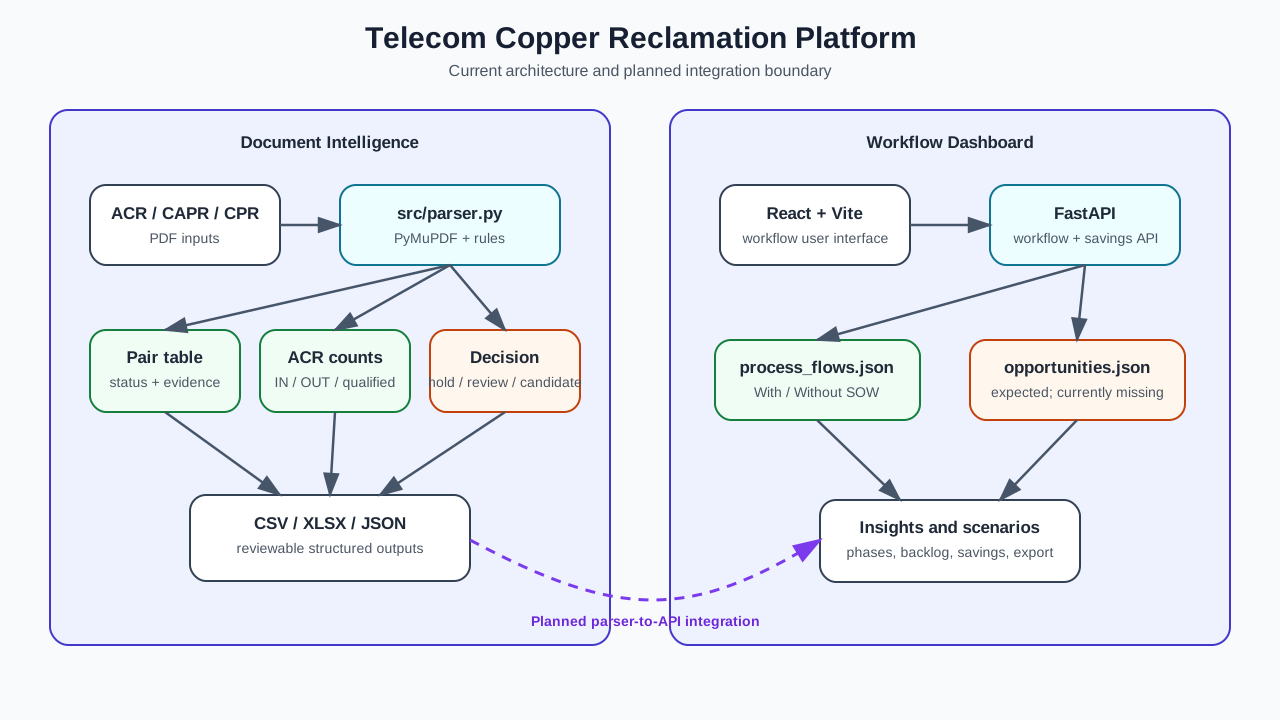
The architecture currently contains two main subsystems.
1. Document Intelligence
The document-intelligence layer receives ACR/CAPR/CPR PDFs, parses report content, produces pair-level and count-level tables, and generates a project summary with warnings and preliminary decision logic.
2. Workflow Application
The workflow layer uses a FastAPI backend and React/Vite frontend to serve and visualize process variants, phase details, automation opportunities, and savings calculations.
The current repository documents a planned integration between parser outputs and the API/dashboard. This connection is a key roadmap item rather than a completed production feature.
Read the Architecture and Design Wiki page
Document Intelligence Pipeline
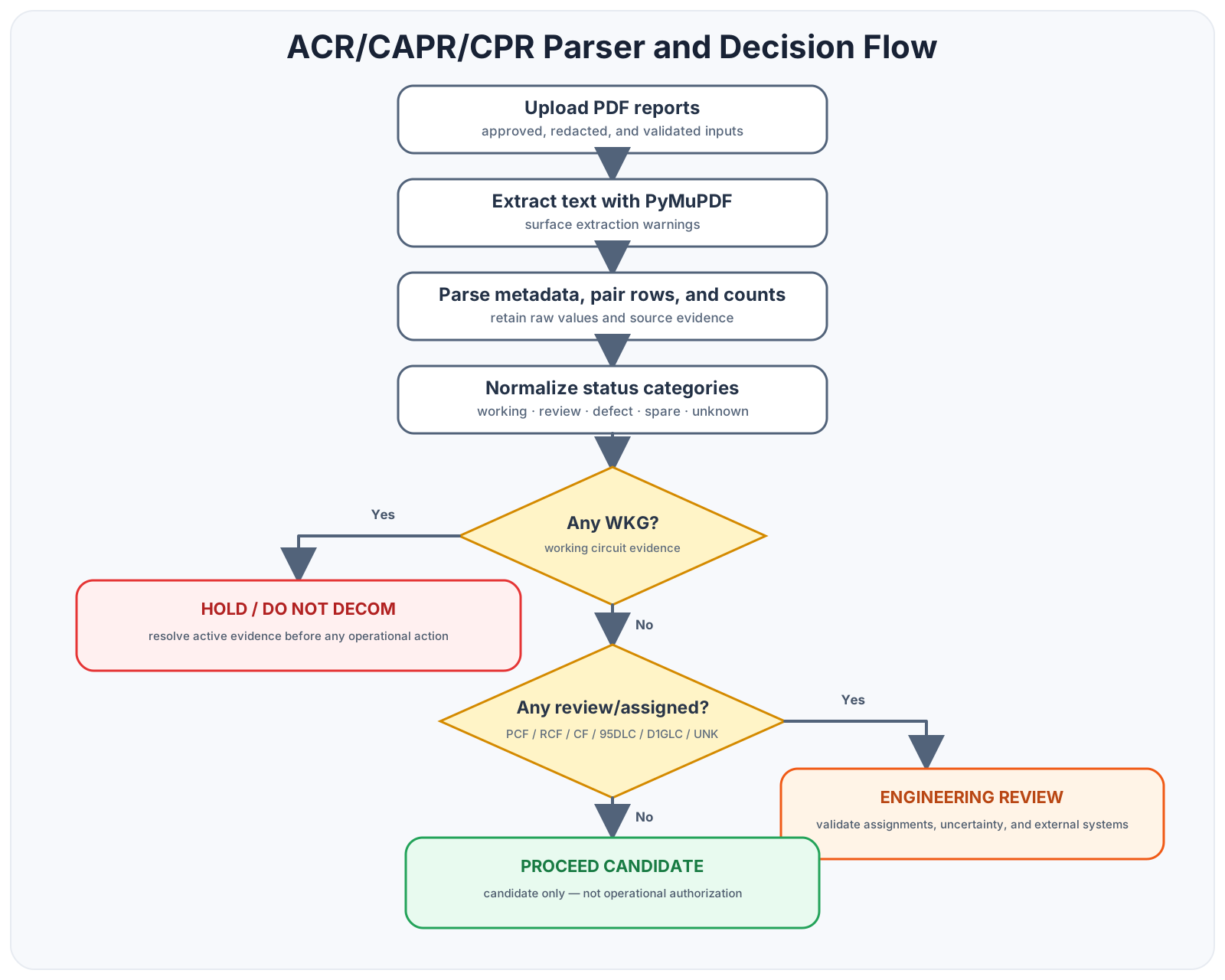
The parser follows a structured sequence:
- Read PDF text.
- Detect whether the document resembles an ACR, CAPR, or CPR report.
- Extract report-level metadata.
- Parse pair-level records and cable/count sections.
- Preserve the original raw status.
- Normalize the status for downstream interpretation.
- Aggregate working, assigned/review, defective, spare, and unknown evidence.
- Generate a preliminary recommendation and warnings.
- Export structured review files.
Supported Report Families
| Report family | Intended evidence |
|---|---|
| ACR | Cable/count relationships, pair information, IN COUNT, OUT COUNT, and QUALIFIED PAIRS sections |
| CAPR | Cable and pair assignment details with related references |
| CPR | Cable/pair status and available service or circuit evidence |
Exact report layouts can vary. A production-grade implementation must maintain layout-specific test fixtures and should never treat “not parsed” as “not present.”
Read the ACR/CAPR/CPR Parsing Wiki page
Extracted Information
Depending on the source report and available text, the parser is designed to organize fields such as:
- source filename and report family;
- report date;
- work center and employee identifier;
- cable identifier and pair range;
- pair number;
- raw pair status;
- normalized status;
- circuit or service identifiers;
- line and pair state;
- binding post and color;
- terminal and location information;
- defect indicators;
- IN COUNT, OUT COUNT, and QUALIFIED PAIRS relationships;
- file-level warnings and recommendation.
For production traceability, every extracted record should additionally retain source page, evidence text, source-file hash, parser version, extraction timestamp, quality flags, and reviewer disposition.
Read the Data Model and Exports Wiki page
Pair-Status Interpretation
The current rule set uses conservative status categories.
| Category | Current values | Interpretation | Preliminary handling |
|---|---|---|---|
| Working | WKG | Active or working evidence | Hold; do not decommission yet |
| Review | PCF, RCF, CF, 95DLC, D1GLC, UNK | Assigned, unresolved, or review-required evidence | Engineering review required |
| Defective | DEF | Defect evidence | Retain and validate disposition |
| Spare | SPR, SPARE | Spare indication | Potential candidate only after validation |
| Unknown | Blank or unrecognized | Insufficiently classified evidence | Manual investigation required |
Raw source values must be retained even after normalization. That allows reviewers to inspect exactly what was present in the source report and prevents the normalized label from hiding parsing ambiguity.
Conservative Decision Logic
The platform deliberately avoids turning report parsing into automatic authorization.
HOLD / DO NOT DECOM YET
Returned when working evidence such as WKG is detected. The result indicates that active evidence must be resolved through authoritative validation.
ENGINEERING REVIEW REQUIRED
Returned when assigned, ambiguous, unresolved, or review-status evidence is present. The project cannot be automatically cleared from the parsed inputs.
PROCEED CANDIDATE
Returned only when the parsed evidence does not contain a working or review-required status.
A PROCEED CANDIDATE result does not prove that the plant is safe to remove. It only means that the parsed reports did not reveal working or review-status evidence under the implemented rules.
Before operational approval, teams must validate live circuit and service records, billing/customer state, pending orders or migrations, field labels and conditions, network topology and design dependencies, environmental and safety constraints, permits, right-of-way requirements, and the approved work package.
Read the complete Decision Logic Wiki page
Workflow Variants
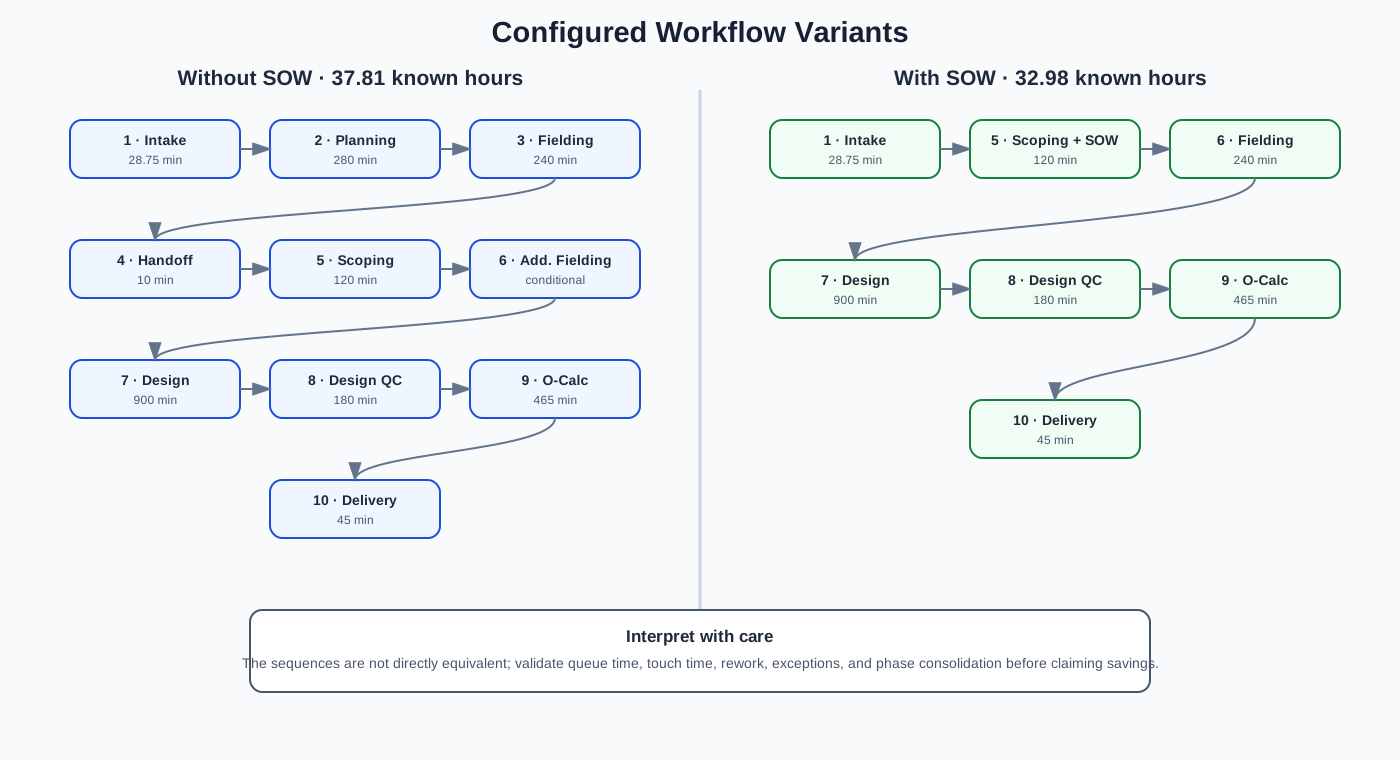
The backend contains two structured process-flow variants.
Without SOW
The current sequence includes:
- Intake
- Planning
- Fielding
- Design Handoff
- Scoping/Pre-Design
- Conditional Additional Fielding
- Design
- Design QC
- O-Calc
- Delivery
The known-duration activities total approximately 2,268.75 minutes, or 37.81 hours, excluding conditional additional fielding.
With SOW
The current sequence includes:
- Intake
- Scoping with SOW
- Fielding
- Design
- Design QC
- O-Calc
- Delivery
The known-duration activities total approximately 1,978.75 minutes, or 32.98 hours.
The raw difference is approximately 290 minutes, or 4.83 hours. However, the sequences are not directly equivalent, and some activities are omitted, consolidated, or conditioned differently. These configured values must not be presented as proven business savings until they are calibrated with controlled operational measurements.
A proper validation study should separately measure queue time, touch time, rework, handoffs, exception rates, systems accessed, role-based loaded cost, completion quality, and comparability between workflow variants.
Read the Workflow Variants Wiki page
FastAPI Service
The backend exposes workflow and savings-related data through FastAPI.
| Method | Endpoint | Purpose |
|---|---|---|
GET | /health | Basic service health |
GET | /api/flows | Return both workflow variants |
GET | /api/flows/{variant} | Return with_sow or without_sow |
GET | /api/summary | Return platform and workflow summary |
GET | /api/automation-opportunities | Return the automation backlog |
POST | /api/savings | Estimate time and cost savings from selected assumptions |
Example savings request:
{ "selected_opportunity_ids": ["opp-1"], "automation_coverage_pct": 50, "jobs_per_month": 20, "work_hours_per_day": 8, "loaded_hourly_rate": 75}The current documented snapshot notes that some endpoints depend on backend/app/data/automation_opportunities.json, which was not visible in the inspected backend data directory.
Read the API Reference Wiki page
React/Vite Dashboard
The frontend is designed as an operational visualization layer for:
- comparing With-SOW and Without-SOW processes;
- viewing phase-level sequence and duration;
- displaying workflow summaries and pain points;
- exploring automation opportunities;
- calculating scenario-based time and cost savings;
- presenting a clearer process narrative to engineering and operations stakeholders.
The application uses React, TypeScript, Vite, Tailwind CSS, Framer Motion, and Lucide React.
The repository documentation identifies two imported frontend components—AutomationBacklog and SavingsCalculator—that were not visible in the inspected component directory. These should be restored or replaced before the frontend is described as a clean end-to-end build.
Read the Dashboard and Frontend Wiki page
Generated Outputs
The parser can support review-oriented outputs such as:
- pair-level CSV;
- ACR count-section CSV;
- project or file decision-summary JSON;
- uploaded-file summary tables;
- XLSX analysis workbooks;
- warnings and reason-code summaries.
Recommended production fields include:
- source filename and cryptographic hash;
- source page and evidence span;
- report type and report date;
- raw and normalized status;
- cable, count, pair, terminal, and circuit identifiers;
- extraction timestamp and parser version;
- validation or quality flags;
- recommendation reason codes;
- reviewer name, review date, disposition, and approval history.
Exports should preserve raw evidence, prevent spreadsheet-formula injection where relevant, classify or watermark sensitive data, and avoid overwriting approved historical records.
Technology Stack
| Layer | Technologies |
|---|---|
| PDF processing | Python, PyMuPDF (fitz) |
| Structured processing | pandas, JSON, CSV, XLSX |
| Backend API | FastAPI, Pydantic, Uvicorn |
| Frontend | React, TypeScript, Vite |
| UI | Tailwind CSS, Framer Motion, Lucide React |
| Testing | pytest |
| Version control | Git and GitHub |
| Documentation | README and 16-page GitHub Wiki |
Repository Structure
AI-Powered-Telecom-Copper-Reclamation-Workflow-Automation-Platform/├── assets/│ └── diagrams/│ ├── platform_architecture.svg│ ├── parser_decision_flow.svg│ └── workflow_variants.svg├── backend/│ ├── app/│ │ ├── data/│ │ │ └── process_flows.json│ │ ├── main.py│ │ └── models.py│ └── requirements.txt├── data/├── docs/│ └── DASHBOARD_DETAILS.md├── frontend/│ ├── src/│ │ ├── components/│ │ ├── App.tsx│ │ ├── api.ts│ │ └── types.ts│ └── package.json├── outputs/├── src/│ └── parser.py├── tests/├── parsed_acr_output.xlsx├── telecom_analysis.xlsx└── README.mdRead the Repository Structure Wiki page
Local Run
Run the PDF Parser
Create and activate a Python environment from the repository root:
python -m venv .venvWindows PowerShell:
.\.venv\Scripts\Activate.ps1pip install pandas pymupdf openpyxl pytestmacOS/Linux:
source .venv/bin/activatepip install pandas pymupdf openpyxl pytestThe parser is currently exposed as a Python library rather than a complete command-line application.
Run the FastAPI Backend
cd backendpython -m venv .venvWindows PowerShell:
.\.venv\Scripts\Activate.ps1pip install -r requirements.txtuvicorn app.main:app --reload --port 8000macOS/Linux:
source .venv/bin/activatepip install -r requirements.txtuvicorn app.main:app --reload --port 8000Useful local URLs:
http://localhost:8000/healthhttp://localhost:8000/docshttp://localhost:8000/api/flows
Run the Frontend
cd frontendnpm installnpm run devFor a custom API URL, create frontend/.env.local:
VITE_API_BASE_URL=http://localhost:8000Read Installation and Local Run
Current Implementation Status
| Capability | Status |
|---|---|
| ACR/CAPR/CPR text extraction | Implemented |
| Pair/status parsing | Implemented using deterministic rules |
| ACR count parsing | Implemented |
| CSV/JSON/XLSX examples | Present |
| Process-flow API | Implemented |
| React/Vite dashboard shell | Implemented |
| Parser-to-dashboard integration | Planned |
| Trained and evaluated AI/ML model | Not present in the inspected implementation |
| Production validation and authorization workflow | Not complete |
| Secure enterprise identity and audit controls | Not visible in the current prototype |
Known Issues
The current Wiki documents the following visible gaps:
automation_opportunities.jsonis referenced by the API but was not visible in the backend data directory.AutomationBacklogandSavingsCalculatorare imported byApp.tsxbut were not visible in the frontend component directory.- Parser dependencies are not declared in the backend requirements file.
- Parser outputs are not connected to the API and UI.
- Tests do not yet validate the complete business behavior.
- Authentication, authorization, secure storage, and audit workflow are not yet visible.
- No trained and evaluated AI model is present in the inspected implementation.
- Sample PDF and XLSX files require privacy and approval review.
- No license file was visible in the documented snapshot.
These limitations are included to keep the portfolio description technically credible and to distinguish the working prototype from the intended production platform.
Roadmap
Phase 1 — Reproducible Prototype
- restore missing backend data and frontend components;
- add root-level dependency management;
- ensure backend and frontend clean builds;
- add configuration validation and graceful error handling;
- introduce continuous integration.
Phase 2 — Tested Document Intelligence
- create synthetic and approved redacted fixtures;
- add golden-file parser tests;
- retain page-level evidence;
- version parser rules;
- measure extraction quality and document-layout coverage;
- add OCR fallback only where justified and evaluated.
Phase 3 — Integrated Review Workflow
- connect secure uploads to parser jobs;
- expose parser evidence through the API;
- add reviewer reason codes and disposition;
- retain a tamper-evident audit history;
- implement governed exports and role-based access.
Phase 4 — Enterprise Integration
- integrate authoritative circuit, billing, GIS, field, design, and permit systems;
- introduce event-driven workflow orchestration;
- add monitoring, observability, and operational support;
- measure cycle-time, rework, quality, and customer-impact outcomes.
Security, Privacy, and Claim Boundary
Telecom engineering documents may contain operationally sensitive information, customer or circuit identifiers, employee identifiers, addresses, facility information, and network-topology details.
Minimum safeguards for any real deployment include:
- synthetic or formally approved redacted data in public repositories;
- encryption in transit and at rest;
- role-based access control;
- strong authentication and authorization;
- secrets outside source control;
- sensitive-field redaction in logs and screenshots;
- retention and deletion rules;
- auditable reviewer and approval history;
- secure export controls;
- human approval before any operational action.
The Project Does Claim To
- structure ACR/CAPR/CPR evidence into reviewable records;
- implement deterministic status normalization and conservative decision support;
- model two reclamation workflow variants;
- provide an API and dashboard foundation;
- document known limitations and a production roadmap.
The Project Does Not Claim To
- authorize copper removal or decommissioning;
- prove that a cable is free of live customer service;
- replace billing, circuit, GIS, field, design, permit, or safety systems;
- provide a fully integrated production platform;
- provide a trained and independently validated AI model;
- provide legal, regulatory, safety, or engineering certification.
Read Security, Privacy, and Claim Boundary
Testing and Validation Strategy
The current tests are starter/import checks. A production validation program should add:
- synthetic and approved redacted document fixtures;
- report-layout-specific unit tests;
- golden-file regression tests;
- malformed, scanned, rotated, and partially readable PDF cases;
- status-normalization boundary tests;
- count-relationship validation tests;
- decision-logic tests;
- FastAPI success and error tests;
- frontend component and end-to-end tests;
- parser-to-dashboard contract tests;
- security, authorization, and audit tests;
- operational validation against qualified engineering review.
Key measures should include field-level precision and recall, row-level extraction accuracy, unparsed-row rate, false-clear rate, document coverage, reviewer agreement, cycle time, rework rate, and exception rate.
Complete Wiki Documentation
| Wiki page | Purpose |
|---|---|
| Wiki Home | Project entry point, safety boundary, maturity, and navigation |
| About the Platform | Problem statement, users, scope, and value |
| Architecture and Design | System layers, data flow, and integration boundaries |
| ACR/CAPR/CPR Parsing | Supported report families, extraction steps, fields, and limitations |
| Decision Logic | Status categories, recommendations, and mandatory external checks |
| Data Model and Exports | Parser outputs, production fields, and export safety |
| Workflow Variants | With-SOW and Without-SOW sequences, durations, and calibration |
| Dashboard and Frontend | React/Vite application structure and UI responsibilities |
| API Reference | FastAPI endpoints, accepted variants, and savings request |
| Installation and Local Run | Parser, backend, and frontend setup |
| Testing and Validation | Test layers and production validation requirements |
| Repository Structure | Folder and file guide |
| Developer Guide | Development, parser-rule, API, frontend, and release checklists |
| Known Issues and Roadmap | Current gaps and phased evolution plan |
| Security, Privacy, and Claim Boundary | Sensitive-data controls and explicit claim limits |
| Quick Links | Fast navigation across all documentation areas |
Practical Use Cases
| User group | How the platform helps |
|---|---|
| Telecom engineering | Structures report evidence and highlights working or unresolved pair conditions |
| Copper-reclamation teams | Provides a consistent preliminary review package |
| Field operations | Identifies evidence and questions that require field validation |
| Planning and design | Makes workflow phases and dependencies visible |
| Quality-control teams | Supports repeatable review fields and reason codes |
| Automation teams | Identifies integration points and repetitive process steps |
| Product and process analysts | Compares workflow variants and configurable savings scenarios |
| Technical reviewers | Provides transparent limitations, diagrams, Wiki pages, and roadmap |
| Data-governance teams | Establishes provenance, export, privacy, and audit requirements |
Key Strengths
- Combines document extraction with workflow modernization.
- Preserves raw source evidence alongside normalized values.
- Uses conservative decisions instead of unsafe automatic clearance.
- Makes the difference between parsing and authorization explicit.
- Documents With-SOW and Without-SOW operating processes.
- Includes a FastAPI backend and React/Vite dashboard foundation.
- Provides structured export examples.
- Includes architecture diagrams and a 16-page GitHub Wiki.
- States implementation gaps and claim boundaries openly.
- Provides a credible path from prototype to governed enterprise platform.
Key Innovation
The strongest contribution is not an unsupported claim of fully autonomous AI. It is the combination of evidence extraction, conservative decision logic, workflow modeling, explainable outputs, and explicit human-approval boundaries in one documented telecom-reclamation prototype.
The system recognizes that missing parsed evidence is not proof of absence and that a report-based recommendation cannot replace authoritative system and field validation. This is critical in infrastructure workflows where an incorrect “clear” decision could affect active service, customer operations, safety, compliance, or network integrity.
Project Links
- GitHub Repository
- GitHub Wiki
- README
- Source Parser
- Backend
- Frontend
- Architecture and Design
- Decision Logic
- API Reference
- Known Issues and Roadmap
Conclusion
The AI-Powered Telecom Copper Reclamation Workflow Automation Platform demonstrates how document intelligence and process automation can be combined to improve a complex engineering workflow.
The parser converts ACR, CAPR, and CPR report content into structured evidence. Conservative decision logic helps distinguish working, unresolved, defective, spare, and unknown pair conditions. The workflow application models two operating variants and creates a foundation for API-driven dashboards, automation backlogs, and scenario-based savings analysis.
The project is most credible when understood as a decision-support prototype and workflow foundation. Its future value depends on rigorous document testing, parser-to-dashboard integration, governed enterprise APIs, strong data protection, measurable operational validation, and mandatory human approval.
Final Thought
Extract the evidence. Preserve the source. Explain the decision. Never confuse a candidate recommendation with authorization.
ACR/CAPR/CPR parsing · conservative pair-status logic · FastAPI · React/Vite · With-SOW and Without-SOW workflows · governed human review · complete GitHub Wiki
Related Technical Projects
Engineering Work Order Profit and Loss Analytics: Synthetic Data Platform for Revenue, Cost, Margin, Billing, and Risk Monitoring
LightDID-ZKP: Policy- and Resource-Aware Selection of BBS and AnonCreds Verifiable Presentations
Comments